
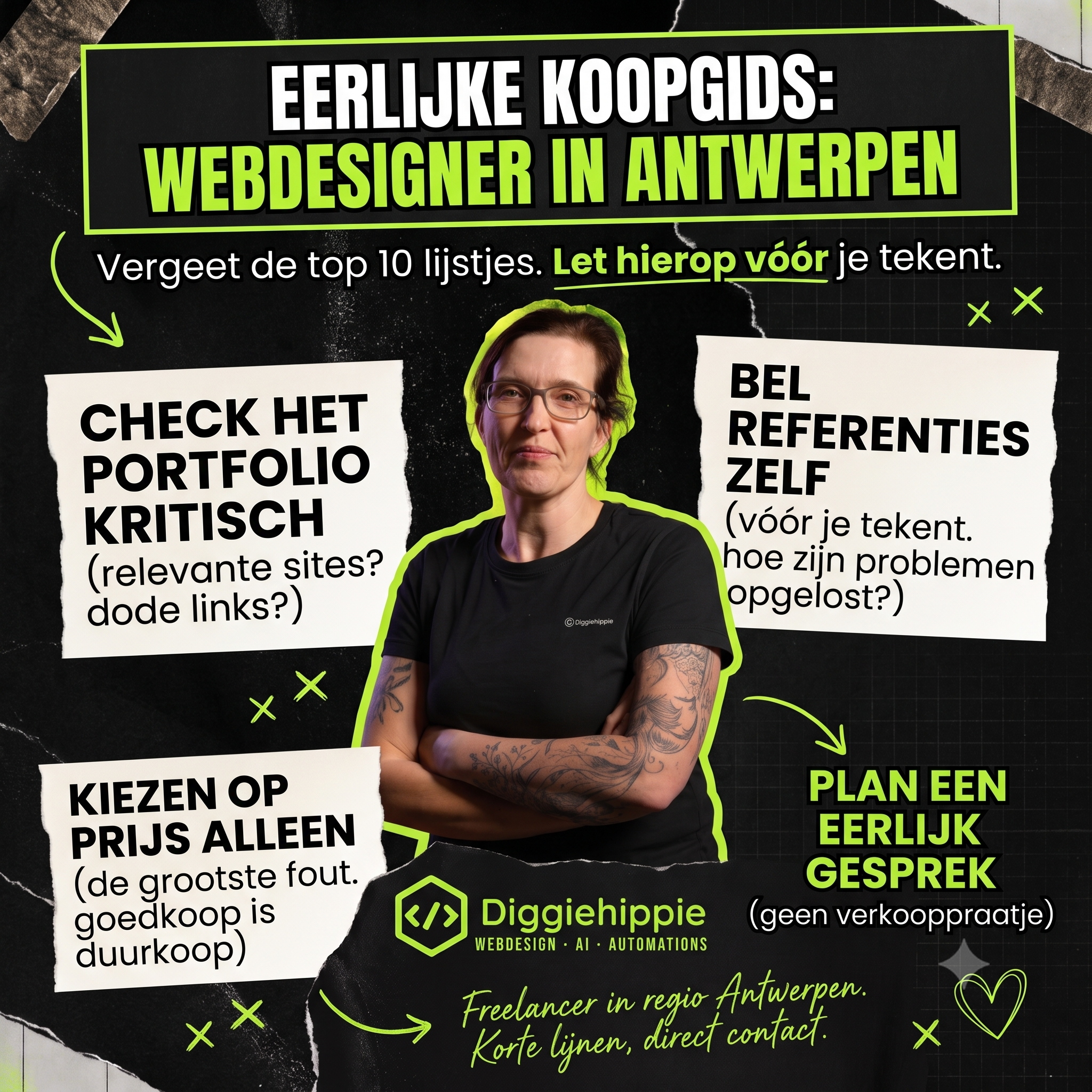
You're looking for a web designer in Antwerp. Just a quick Google search, you think. Check out a few websites, compare prices, and make your choice.
Until you have five quotes, each offering something different. With one, you provide everything yourself. With another, maintenance is included. And what exactly do they mean by “SEO included”?
How do you compare that?
I build websites myself from Massenhoven, in the Antwerp region. So I have a vested interest in this topic. I’d rather say that right away. With this guide, I want to help you ask the right questions so you know who you’re working with and what you’re getting for your budget.
Start by figuring out what your website needs to do
Before you choose a web designer, it helps to write down why you need that website.
Do you want to receive inquiries? Sell products? Let people book workshops? Or, above all, clearly explain what you do?
You don't have to choose a platform or plugins just yet. A good web designer will help you make that decision based on your needs.
Also, tell us what challenges you're facing right now. Maybe you keep getting the same questions in your inbox. Maybe you're manually retyping registrations. Or maybe visitors can't find what you're offering.
Those are useful starting points. They provide more direction than “I want a modern website.”.
A freelancer or an agency?
Either option might be right for you. It depends on your project and how you want to collaborate.
When working with a freelancer, you often work directly with the person building your website. That can be nice: you explain something, and that same person gets right to work on it.
Be sure to ask what the schedule looks like and how support is arranged in case of absence. After all, one person’s schedule is limited.
An agency can bring in various specialists. This can be helpful when you need design, development, copywriting, and marketing all at the same time. Ask who your point of contact will be and how the team shares information.
A large team is no guarantee of better results. Neither is having a single point of contact. Above all, make sure the expertise, approach, and available time are a good fit for your project.
Look beyond a beautiful portfolio
A portfolio gives you a first impression. But be sure to click through to the websites themselves as well.
Can you easily find out what the company does on your cell phone? Do the menus work? Is it clear how to get in touch or place an order?
Next, ask what the web designer did for that project. Just the design? The development, too? The copy? The maintenance?
That way, you'll know which experience you're actually watching.
Also look for projects with similar questions. It doesn't have to be exactly your industry. For example, a website that processes registrations could be relevant to various types of entrepreneurs.
Is there an old or broken link? If so, ask for a recent example. The client may have stopped using the service or may have changed their website in the meantime.
Pay attention to the communication before you sign
The proposal phase already gives you an idea of how the collaboration might go.
Are you getting clear answers? Is anyone asking questions about your offerings and your clients? Is it being explained why a feature is or isn't necessary?
You don't need to be able to have a technical conversation to order a website. You have the right to expect someone to explain their proposal in a way that's easy to understand.
Also ask how the project is progressing in practical terms:
- When will you provide the text and images?
- How do you give feedback?
- How many rounds of feedback are included?
- Who is in charge of the schedule?
- What happens if something comes up along the way?
Those aren't difficult questions. They prevent both of you from starting out with different expectations.
How much does a web designer cost in Antwerp?
A figure alone isn't very helpful if you don't know what's included in it.
A website with pre-written content and a contact form requires different work than an online store with product variations, payment options, and automated follow-up. Therefore, even two websites with the same number of pages can have different costs.
Request a quote that describes what will be built, what you will provide, and which costs will be billed separately.
Would you like to estimate a budget first? Read my article How Much Does It Cost to Have a Website Built? Prices for Self-Employed Individuals in 2026. There, I explain what determines the price and what recurring costs you can expect.
Then compare them on the same basis. For each quote, consider the following:
| Component | What would you like to know? |
|---|---|
| Pages and Features | What exactly is being built? |
| Text and images | Who creates and posts the content? |
| Feedback | How many rounds of revisions are included? |
| Software | Which plugins, apps, and licenses do you pay for separately? |
| Completion | What kind of checks and explanations will you receive? |
| Support | What's included after the launch? |
A cheaper option might be right for you. So might a more expensive one. Above all, you want to understand what you're paying for.
Who owns your domain, website, and accounts?
It's easy to forget this—until you want to change something and realize you don't have access to anything.
Question before we begin:
- In whose name is your domain name registered?
- Who manages the hosting and any software subscriptions?
- What kind of access do you have to your website?
- What can you customize yourself?
- What usage rights apply to designs, text, images, and software?
- Can you switch to a different service provider later, and how does that work?
A managed service can work just fine. You don't have to monitor every technical account yourself. But you do need to know how it's set up and what happens if you end the partnership.
Ask that this be documented in writing as well. That way, you won't have to try to figure out later who remembers which conversation.
What can you expect upon delivery?
A working contact form, agreed-upon pages, and a functional mobile view are specific things you can check.
Agree on what will be tested and when the website will be ready for delivery. For an online store, for example, you’ll also want to check the ordering, payment, and confirmation email processes. For a booking system, you’ll want to verify the entire booking process.
Also, ask how errors are handled after delivery. What is considered part of fixing a problem within the scope of the agreed-upon work? And what constitutes a new request that requires additional work?
That distinction helps both sides.
Delivering on an agreed-upon feature is different from predicting how many clients your website will attract. When someone makes promises about revenue or Google rankings, ask how they back those up. Such results also depend on your offering, the competition, your marketing, and what happens after the launch.
What does “SEO included” mean?
That should be more specific than just one line on the quote.
Ask what features are included. Consider the page structure, headings, mobile functionality, technical accessibility for search engines, and any assistance with keywords and content.
Also ask whether this refers to the initial phase of construction or to follow-up work after launch.
This prevents you from expecting months of support when the web designer is only referring to the initial setup upon delivery.
Who is responsible for privacy, cookies, and other issues?
When it comes to forms, tracking, payments, and AI features, you also need to consider what data you collect and what information you provide to your visitors.
Ask who provides the text and instructions, who handles the technical setup, and whether specialized oversight is required.
I’ll incorporate those points into the project and let you know where additional advice might be needed. I’m not a lawyer myself. Therefore, the agreements regarding what I’ll do and what you need to provide must be clear.
Do you use a chatbot? If so, information for visitors about that AI feature should also be part of the conversation. I discuss that topic in more detail in my article on chatbots and AI transparency.
And after the launch?
Your website is live. But maybe three weeks later, you'll want to replace a photo, add a service, or find out why an email isn't getting through.
Ask in advance how they will assist you.
Can you make basic adjustments yourself? Do they provide instructions? Is there a maintenance package? What tasks are included, and what is billed separately?
Website development, maintenance, and new features are separate agreements. If that’s clear from the start, you’ll know where to turn even after the launch.
Does your web designer really have to be based in Antwerp?
That depends on how you like to discuss things.
Do you prefer to have a local point of contact? If so, location is a useful selection criterion. If you prefer to work online, you can also broaden your search.
Be sure to ask how the meetings are going and whether they fit with your schedule. Just because someone has an address in the area doesn't necessarily mean they're easy to reach.
I’m based in Massenhoven, in the Antwerp region. During our first meeting, we’ll discuss your needs and how we can practically approach our collaboration.
Frequently Asked Questions
How do I choose a web designer in Antwerp?
Start by defining what your website needs to do. Next, review relevant projects, ask questions about the process, and compare quotes based on their content. Also, verify access, usage rights, and post-delivery support.
Can I make changes to my website myself later on?
That depends on the platform and the setup. Let them know in advance which parts you want to manage yourself. Also ask what kind of guidance you’ll receive.
Can I switch to another web designer later?
Before you start, ask how the transfer will be handled. Consider the domain, hosting, access, files, and licenses. The options depend in part on the platform and the agreements that have been made.
Is maintenance included?
That varies by quote. Ask which tasks are included, for what period, and under what terms. Don't automatically assume that maintenance is included in the construction price.
Would you like to see if we're a good fit?
Tell me what you do, what your website needs to be able to do, and where you're currently running into problems.
You don't have to have your ideas laid out in a technical brief just yet. I'll help you with that. We'll figure out what's necessary, what can wait, and how that fits within your budget.
At Diggiehippie, you'll be talking directly with me. You can read ahead to find out how I website development, or schedule a no-obligation consultation.
 Dutch
Dutch  English