
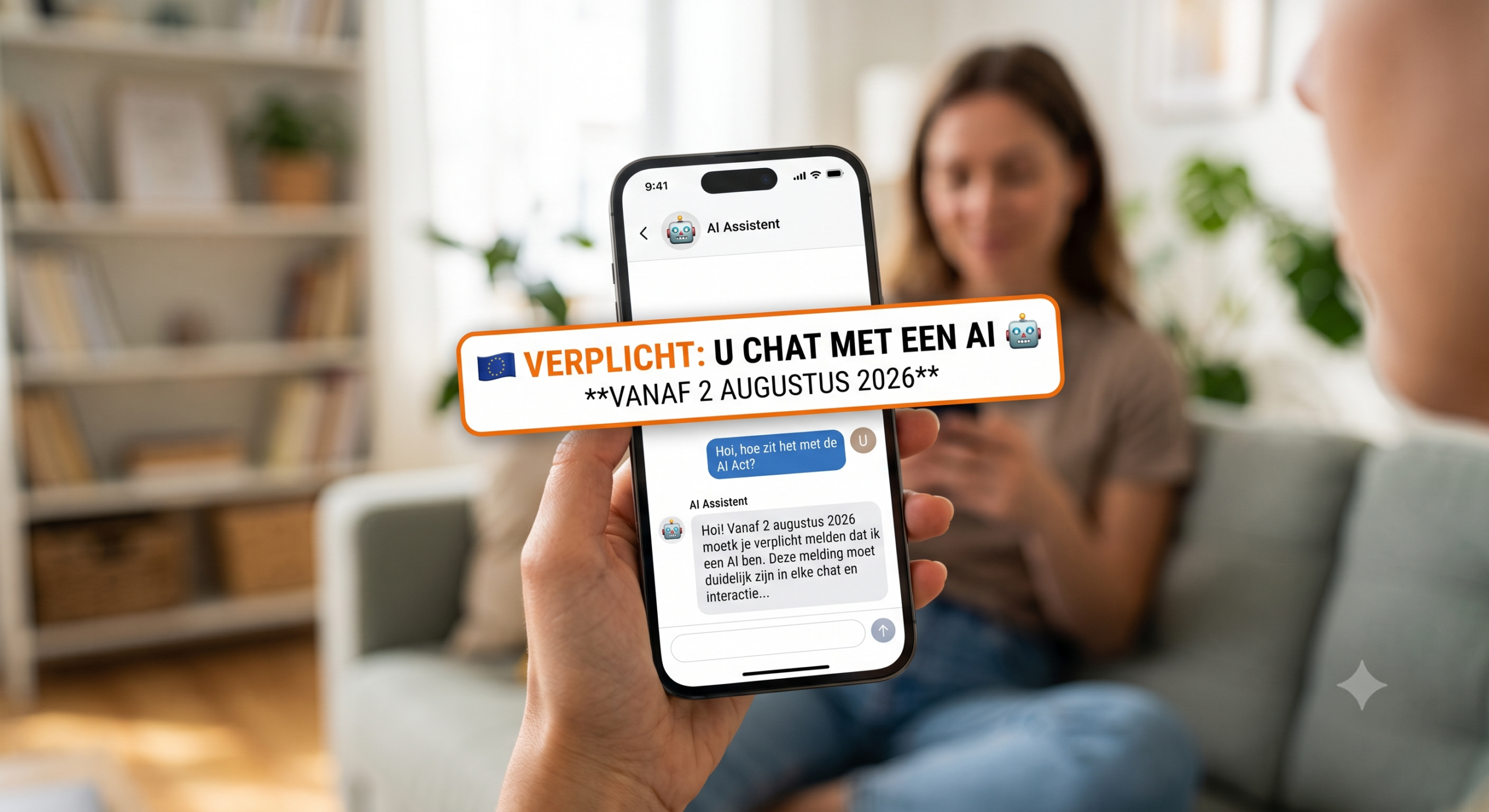
Starting August 2, 2026, the European AI Act requires every website with a chatbot to clearly inform visitors that they are interacting with AI and not a human. This requirement is set forth in Article 50 and also applies to self-employed individuals and small businesses. The change itself is minor, but failing to comply could prove costly.
In this article, you'll learn exactly what's changing, whether it applies to you, and what specific steps you need to take. No legal theory—just practical advice for a standard business website.
What will change on August 2, 2026?
The AI Act was adopted in 2024 and will take effect in phases. On August 2, 2026, the transparency requirements set forth in Article 50 will become enforceable. From that date onward, the following will apply, among other things:
- Chatbots must identify themselves as AI. Anyone who interacts with an AI system needs to know this from the very first interaction. A single sentence tucked away in your terms and conditions isn't enough.
- AI-generated images and videos must be labeled as artificially created or altered. This is certainly true of deepfakes—that is, images of real people.
- Texts written entirely by AI on topics of general interest must be labeled as AI-generated, unless a human has editorially reviewed the text and takes responsibility for it.
Important to know: Earlier this year, a decision was made at the European level to postpone part of the AI Act. That postponement applies to the stringent requirements regarding high-risk systems, not to Article 50. The August 2 deadline remains in effect.
Does this apply to you?
Probably so, as soon as you visibly use AI in your dealings with customers. The law distinguishes between who builds an AI system (the provider) and who uses it (the user or “deployer”). As a self-employed person or SME, you almost always fall into the second category. Even then, you have obligations.
Specifically, you fall under Article 50 if you:
- you have a chatbot or AI assistant on your website, even if it comes from a third-party provider
- Publishes AI-generated images or videos, for example, in your marketing
- publishes texts generated entirely automatically, without human editing
There is no general exception for small businesses. The size of your business does not affect the reporting requirement itself.
What You Need to Do, Specifically
Your chatbot
Make sure your chatbot introduces itself as an AI during the first interaction. An opening message along the lines of “Hello, I'm the virtual assistant for [company name]” is sufficient, as long as it is immediately visible. The notice must be clear and understandable, including for people with disabilities.
Your AI-generated content
There is an exception when it is abundantly clear to a reasonably observant visitor that AI is involved. Don’t count on that too quickly. For a typical business website, that’s rarely obvious.
If you publish AI images or AI videos, be sure to indicate that they are artificially generated. The technical aspects of this, such as machine-readable watermarks, are largely the responsibility of the provider of the AI tool you’re using. Your job is to choose a tool that supports this and to include the visible disclosure where necessary.
What Isn't Necessary
This is where things most often go wrong in the opposite direction: companies that think they suddenly have to put “made with AI” on everything. That’s not the case.
- AI used as a behind-the-scenes tool is exempt from the labeling requirement. A quote that you draft with the help of AI and proofread yourself does not need a label.
- A blog post for which AI wrote the first draft—and which you have revised and are publishing under your own name—does not need to be labeled. However, the human editing must be genuine, not just a quick glance.
- Internal documents and communications are not subject to these rules.
Fines and Enforcement
On paper, fines for violations of Article 50 can amount to 15 million euros or 3 percent of global annual revenue. For an SME, this is primarily a signal that the grace period is over. In practice, enforcement typically begins with a warning and a grace period. Those who have their fundamentals in order need not lose any sleep over this.
In most cases, making this change will take you less than an hour. The risk of doing nothing is disproportionately greater.
Checklist: Ready for August 2
- Do you have a chatbot? Add a clear AI notice to the opening message.
- Do you use an external chatbot tool? Ask your vendor how they support Article 50 and document that.
- Make an inventory of the AI images and AI videos on your website and social media, and include a credit where necessary.
- Do you publish AI-generated content? Ensure it has been verifiably edited by a human, or label it as such.
- Make a note of what you've changed and when. If a regulator asks questions, that will be your first line of defense.
Need help?
Ik volg de wetgeving rond AI op via een terugkerend juridisch overleg en vertaal ze naar wat ze concreet betekent voor de websites en automatisaties die ik bouw. Twijfel je of jouw chatbot of AI-content in orde is, dan bekijk ik dat graag met je. Let wel: ik ben geen jurist. Voor juridisch advies op maat verwijs ik je door naar een gespecialiseerde advocaat – Sirius Legal Advocaten schreef een goed overzicht over de deepfake-regels en de nieuwe ontwerprichtlijnen onder artikel 50.
Frequently Asked Questions
Does my chatbot have to disclose that it's AI?
Ja. Vanaf 2 augustus 2026 moet elke chatbot die rechtstreeks met bezoekers praat, bij de eerste interactie duidelijk maken dat het om AI gaat. Een zichtbare vermelding in het openingsbericht volstaat, bijvoorbeeld: “Hallo, ik ben de virtuele assistent van [bedrijfsnaam].” Gebruik je een chatbot van een externe leverancier, dan blijft de meldplicht bij jou liggen. Vraag dus na of en hoe die tool dit ondersteunt. Een zinnetje verstopt in je algemene voorwaarden volstaat niet; de melding moet meteen zichtbaar zijn voor de bezoeker, ook voor mensen met een beperking.
Does the AI Act also apply to small businesses and the self-employed?
Ja. De transparantieverplichtingen uit artikel 50 kennen geen uitzondering op basis van bedrijfsgrootte. Ook een eenmanszaak met een chatbot op de website moet de melding voorzien. De wet maakt wel onderscheid tussen wie een AI-systeem bouwt (de aanbieder) en wie het gebruikt (de “deployer”). Als zelfstandige of kmo val je bijna altijd onder die tweede categorie, en ook dan gelden er verplichtingen. In de praktijk begint toezicht doorgaans met een waarschuwing en een hersteltermijn, niet meteen met een boete.
Do I need to label all my texts when I use AI to write?
Nee. Gebruik je AI enkel als hulpmiddel en herwerk je de tekst zelf voor je ze onder je eigen naam publiceert, dan is er geen labelplicht — een offerte die je met AI-hulp opstelt en zelf naleest, hoeft bijvoorbeeld geen label. Enkel volledig AI-gegenereerde teksten over onderwerpen van algemeen belang, zonder échte menselijke redactie, moeten als AI-gegenereerd gelabeld worden. De menselijke redactie moet dan wel oprecht zijn, niet enkel een snelle blik. Interne documenten en communicatie vallen sowieso buiten deze regels.
 Dutch
Dutch  English